
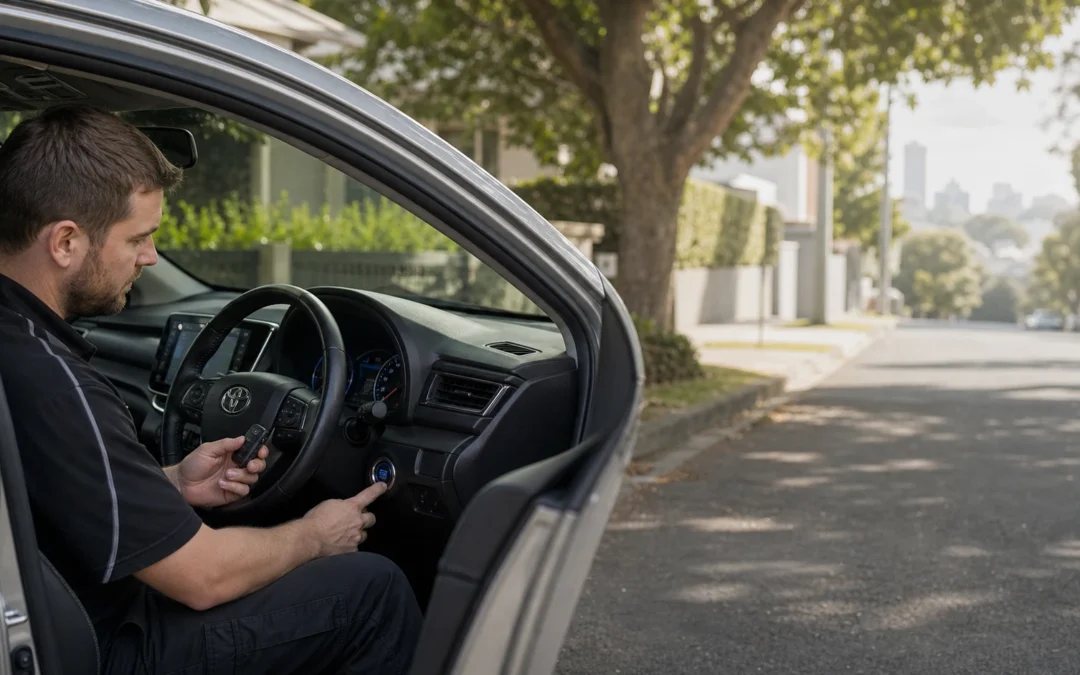
A smart key rides through a wash cycle in a jacket pocket left on the passenger seat of a Mazda CX-5 parked in Bulleen.
It still looks fine afterward, but the car will not unlock when the owner walks up to it, and the push-button start does nothing once she is inside. Water and electronics do not mix, and a modern smart key is mostly electronics wrapped in plastic.
The mechanical backup blade tucked inside the fob gets the door open, but the engine stays dead until the electronics either dry out and recover or get replaced outright, and there is rarely a way to tell which outcome is coming without opening the key up.
Three Different Things People Call a “Car Key”
A basic remote is a small fob with buttons for locking and unlocking, paired with a separate metal key that goes in the ignition barrel. A remote head key combines both into one unit, with the remote buttons built into the head of the key itself, still inserted into the barrel to start the car.
A proximity smart key, sometimes called a keyless entry key, does away with the metal blade almost entirely for daily use.
It sits in a pocket or bag, unlocks the doors when the owner’s hand touches the handle, and starts the engine with a dashboard button as long as the key is somewhere inside the cabin.
Nearly all proximity keys still hide a small mechanical blade inside the fob itself, accessed by a release catch, purely as a backup for when the internal battery dies completely.
Drivers who have owned a smart key for years are sometimes unaware this blade exists until the day the fob goes flat and the driver’s door will not open without it.
Why Smart Keys Cost More to Replace
A basic remote and blade combination is largely mechanical, with a simple circuit board handling the lock and unlock signal.
A proximity smart key packs in a two-way radio transceiver, a backup transponder chip, a capacitive touch sensor in the door handle circuit, and firmware that constantly exchanges encrypted signals with the car to confirm it is nearby.
More components and tighter manufacturer security around proximity systems both push the price up.
The key itself typically costs more to source than a basic remote, and the programming session usually takes longer since the car has to learn to recognise the key at multiple distances and trust levels rather than a single on/off signal.
What Actually Fails Inside a Smart Key
The most common smart key fault is nothing more than a flat coin-cell battery, the small round battery inside the fob that powers its constant low-level communication with the car. A weak battery causes intermittent range problems, like needing to stand right next to the door for it to unlock, well before it fails completely.
Water damage corrodes the circuit board or shorts the battery contacts, usually beyond repair once corrosion sets in, even if the key still looks intact from the outside.
A cracked case from being dropped or sat on can snap an internal antenna wire without leaving any visible external damage, which is why two keys that look equally fine can behave completely differently.
Not every no-start problem traces back to the key at all.
The car’s own receiver antenna, often built into the dashboard or console near the ignition, can fail or lose connection, and a flat 12-volt battery in the vehicle itself can starve the receiver of power even when the key is working perfectly.
Ostan Locksmiths’s OBD diagnostic equipment checks the vehicle side of the system as well as the key, so the fault gets identified correctly before any part gets replaced unnecessarily.
Battery Swap First, Replacement Second
Because a dead battery is the single most common cause of a smart key that suddenly stops working, it is worth ruling out before assuming the whole unit needs replacing. Most smart keys use a standard, widely available coin-cell battery that costs a fraction of a full key replacement.
- Check the owner’s manual or the key’s plastic casing for the exact battery type, usually a CR2032 or CR2025
- Look for a small release catch or screw to open the fob without cracking the casing
- Replace the battery with the terminals facing the same direction as the old one
- Test the key at a normal distance from the car before assuming it still is not working
If the key still fails to unlock or start the car after a fresh battery, the fault sits deeper in the electronics or the antenna, and it is time to call a locksmith rather than keep guessing.
Programming a Replacement On Site
Ostan Locksmiths carries dealer-level programming tools that can pair a new proximity smart key or remote head key directly through the vehicle’s OBD port, in the same visit as sourcing and cutting any physical blade the key still needs as a backup.
This mirrors the process used for standard transponder key programming, but with an extra pairing step for the proximity radio signal on top of the immobiliser chip.
A dealership can do the same work, but usually only by appointment, often a week or more out, and only at the dealership’s premises rather than wherever the car happens to be.
A mobile visit to a driveway in Donvale or a workplace car park in Doncaster removes both the wait and the need to arrange a lift to and from the dealer.
Some Models Need Every Key Present to Program a New One
A handful of proximity key systems, more common on European models, require every key currently paired to the car to be present during programming, not just the new one being added. Missing one from a set of three means the whole system has to be reset from scratch rather than simply adding the fourth.
Most Asian and Australian-delivered vehicles are more forgiving and allow a new key to be added without the others present, though the exact behaviour depends on the immobiliser software each manufacturer uses. Confirming this detail before the visit avoids an awkward surprise on the day.
Some manufacturers also cap the total number of keys a vehicle can have paired at once, commonly four or eight depending on the model.
A household replacing a lost key on a car that already has several spares floating around sometimes needs an old, unused key deleted from memory before a new one can be added, which the same on-site programming session handles.
Aftermarket Keys Versus Genuine Manufacturer Keys
A genuine key sourced through the manufacturer’s parts network carries the exact case, buttons, and internal chip the vehicle shipped with, at a higher price than most aftermarket alternatives.
Aftermarket proximity keys, built by third-party electronics manufacturers to match the same radio frequency and protocol, cost less and work perfectly well on most makes once programmed correctly.
The gap in reliability between the two has narrowed significantly over the past decade as aftermarket manufacturing quality improved, though a handful of European models remain fussy about accepting anything other than a genuine unit.
Ostan Locksmiths can advise which route suits a given vehicle once the make, model, and key generation are confirmed, rather than defaulting to the most expensive option automatically.
Replacing a Smart Key When None Are Left
Losing the only smart key, or having the sole remaining one stop working entirely, is a more involved job than adding a spare, since the car has no working key left to authenticate a new one against.
It generally means accessing the immobiliser through the key code or VIN rather than through an existing paired key.
The cost of a full smart key replacement also depends heavily on the brand and key generation, since some manufacturers changed proximity systems multiple times across a single model’s production run.
A Toyota RAV4 built in 2015 and one built in 2022, for instance, can use entirely different proximity systems despite sharing a model name, which affects both parts sourcing and programming time.
Our guide on what car key replacement costs in Doncaster breaks down the main factors that push a quote up or down.
Getting a Working Key Back the Same Day
A smart key that has stopped responding does not mean a car sitting idle for a week waiting on a dealership slot.
Ostan Locksmiths brings the diagnostic tools, replacement fobs, and blade-cutting equipment needed to sort out proximity keys, remote head keys, and basic remotes for Toyota, Mazda, Hyundai, Ford, Holden, and European makes across Doncaster and the wider Manningham area.
Anyone with a fob that has gone quiet, gotten wet, or simply vanished can call 0410 380 354 or get a free quote from Ostan Locksmiths for an exact price once the vehicle and key type are confirmed.
Our car key programming service covers everything from a simple pairing to a full all-keys-lost recovery, with an upfront quote given before any work begins so there are no surprises once the job is done.