
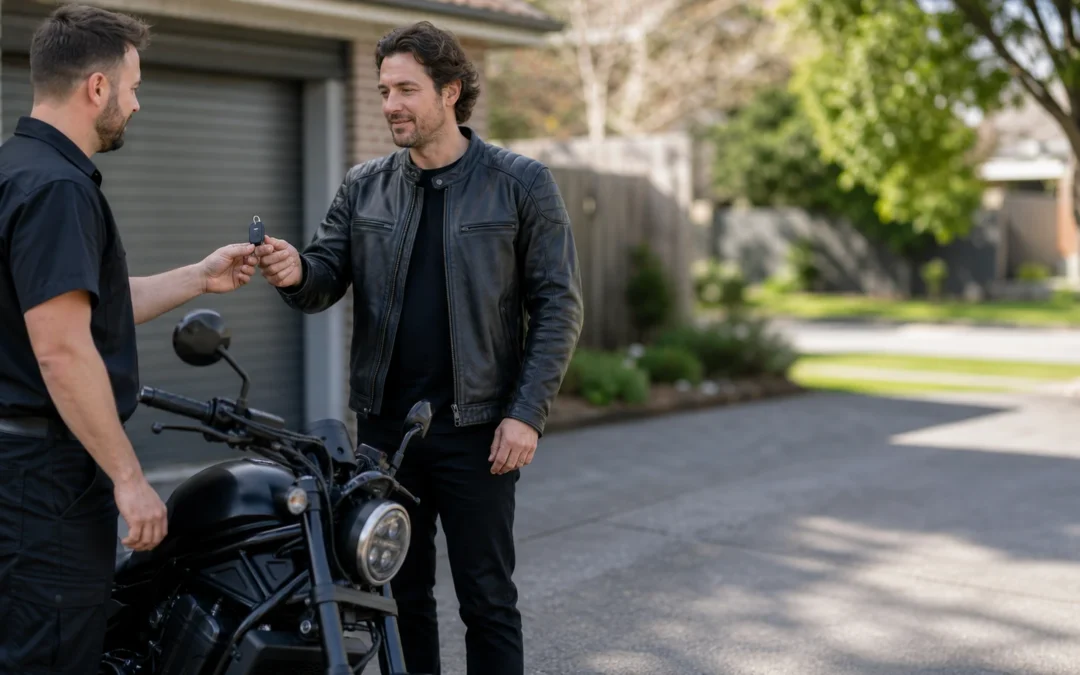
A motorcycle sitting in a garage in Doncaster East with no working key and nothing left to copy from leaves the owner with two real options: call a mobile locksmith or call the dealership.
Both can produce a new key using the bike’s VIN, but the process, the timeline, and the hassle involved differ substantially, and knowing the difference in advance saves a lot of wasted phone calls when the bike is actually stuck.
What the VIN and Key Code Actually Provide
Every motorcycle’s Vehicle Identification Number uniquely identifies that specific bike, and manufacturers tie the original key cut specification and transponder data to that number in their production records.
A separate, shorter key code, sometimes issued on a card or tag at the time of original purchase, can serve the same purpose if the VIN lookup does not return complete data.
Either number gives a starting point for producing a correct key without needing the original in hand.
This matters most when every key for a bike has been lost, stolen, or damaged beyond use, since there is nothing physical left to copy the cut from.
The VIN itself is usually stamped into the steering headstock and printed on the compliance plate, and it also appears on the vehicle’s registration papers, which is useful to know before making contact with anyone about a replacement.
Riders who cannot locate a physical VIN stamp, sometimes worn or obscured on older bikes, can still generally rely on the number printed on their registration certificate.
The separate key code tag, where one exists, is often tucked inside the owner’s manual or the toolkit pouch under the seat, easy to overlook until the day it is actually needed.
Proving Ownership Before Any Key Is Cut
Because a VIN alone could, in theory, let anyone order a working key for a bike they do not own, a locksmith asks for proof of ownership before cutting anything, typically photo identification matched against the registration papers or a recent rego renewal notice.
This is a standard safeguard across the locksmithing trade, not a delay unique to any one provider, and a dealership applies the same requirement before releasing an OEM part.
Having these documents ready before the locksmith arrives, rather than searching for them once the visit has started, is one of the simplest ways to keep a VIN-based replacement moving quickly.
Riders who have recently bought a bike secondhand and not yet transferred the registration into their own name should expect this step to take a little longer while ownership is confirmed.
How a Locksmith Cuts and Codes a Key From VIN Alone
A locksmith with access to key code databases looks up the cut specification tied to the VIN, then cuts a blank to that exact factory profile using a dealer-level key cutting machine carried on the mobile van.
The blade alone will not start the bike on models with a transponder immobiliser, so the next step is coding the chip to the bike’s ECU using OBD diagnostic and key coding tools, done on site rather than sent away.
The full process, cutting and coding, typically happens in one visit wherever the bike is parked, whether that is a driveway in Templestowe or a workplace car park in Bulleen.
On bikes where the key code lookup returns an exact match, the whole job can be finished in well under an hour, including a test start before the locksmith leaves.
More detail on how the transponder side of this works is covered in motorcycle transponder and immobiliser key programming in Doncaster.
The Dealership Route: Ordering an OEM Key by VIN
A dealership follows a broadly similar first step, looking up the bike’s key data against manufacturer records using the VIN.
From there, the dealer typically orders an original equipment key or fob through the manufacturer’s parts network rather than cutting one from stock, then books a service appointment to program it once the part arrives.
Proof of ownership is required here too, and for a bike reported stolen and recovered, some dealers also ask for supporting police report details before releasing a key.
This route produces a factory-original key and is sometimes the only option for very new models or bikes still tied to specific warranty documentation requiring dealer-sourced parts. Booking a dealership appointment can itself take time during busy periods, particularly over the warmer riding months when workshop diaries fill up quickly.
Wait Times: Same Day Versus Backorder
A mobile locksmith carrying the correct blanks and coding tools can generally complete the cut and programming in a single visit, often the same day the call comes in, since the common blanks for mainstream brands are already stocked on the van rather than ordered in specifically for the job.
A dealership’s timeline depends on part availability, and for less common models, certain Ducati, Triumph, or specialty Harley-Davidson variants in particular, the required key or fob may need to be shipped interstate or from overseas, adding days or weeks before an appointment can even be booked.
Mainstream Japanese brands are usually quicker to source through a dealer than European ones, though still slower than a same-day mobile visit in most cases.
For a rider who needs the bike back in use for a daily commute, that difference in wait time is often the deciding factor on its own.
Getting the Bike There: Towing Versus Mobile Service
A bike with no working key cannot be ridden to a dealership, which means getting it there at all requires a trailer, a ute, or a tow truck booked and paid for separately from the key replacement itself.
Not every towing company carries a bike-rated trailer or the soft straps needed to secure a motorcycle safely, so finding the right operator can itself take longer than expected.
That logistics step alone can take as long as the key job, and a bike left in a public car park waiting on a tow booking also carries some risk of further tampering or theft.
A mobile locksmith removes this step entirely by bringing the cutting machine, coding tools, and OBD diagnostics to wherever the bike is sitting. Full details on the replacement process are on the motorcycle key replacement page.
Comparing the Overall Cost
Between parts, dealer programming labour, and the cost of getting the bike to the workshop, the dealership route generally adds up to more than a mobile locksmith’s on-site cut-and-code service, though the exact gap depends heavily on the bike’s make and key complexity.
A locksmith visit is usually one combined callout covering the cut, the coding, and the visit itself, while a dealership more often itemises the part, the diagnostic time, and the labour as separate line items, plus whatever towing or trailering was arranged separately.
High-security systems on some Ducati and BMW models, which use ECU-linked master keys rather than a simple cut blade, can push pricing up under either route.
Because every bike and situation is different, specific figures and what drives them are broken down in how much does motorcycle key replacement cost in Doncaster, and for an exact price on a specific bike, request a free quote from Ostan Locksmiths.
Which Route Actually Suits Which Situation
For the vast majority of bikes on Manningham roads, Hondas, Yamahas, Suzukis, Kawasakis, and most Harley-Davidsons, a locksmith working from the VIN or key code covers the job fully, with no need to involve the dealer at all.
Dealership involvement makes more sense only when a bike is brand new enough that aftermarket key code data has not caught up yet, or when warranty terms specifically require dealer-documented parts.
A bike being replaced under an insurance claim may also need the insurer’s preferred process followed, which is worth checking before booking either option.
Outside those edge cases, choosing between the two comes down to how quickly the rider needs the bike back and how much extra effort they are willing to put into getting it to a workshop.
A rider weighing up both options is also welcome to call and describe the bike and situation before committing to either route.
Why Mobile Service Wins for Time-Poor Riders Across Manningham
Manningham is the only metropolitan Melbourne council area without a train line or tram, so a bike sitting immobile in Donvale or Doncaster East is not something most residents can work around by catching public transport in the meantime.
Losing every key to a primary form of transport carries more weight here than in suburbs with rail options nearby, particularly for riders who use the bike as their main means of getting to work rather than for weekend riding alone.
A locksmith reaching the bike directly, wherever it sits between Warrandyte and Ringwood North, resolves the actual bottleneck rather than shifting it onto a tow truck booking.
For a household with only one working vehicle available while the bike is out of action, closing that gap quickly matters more than shaving a small amount off the total bill.
Call Ostan Locksmiths on 0410 380 354 with the bike’s VIN or registration details ready, and a same-day on-site visit can usually have a coded key in hand well before a dealership order would even arrive.