
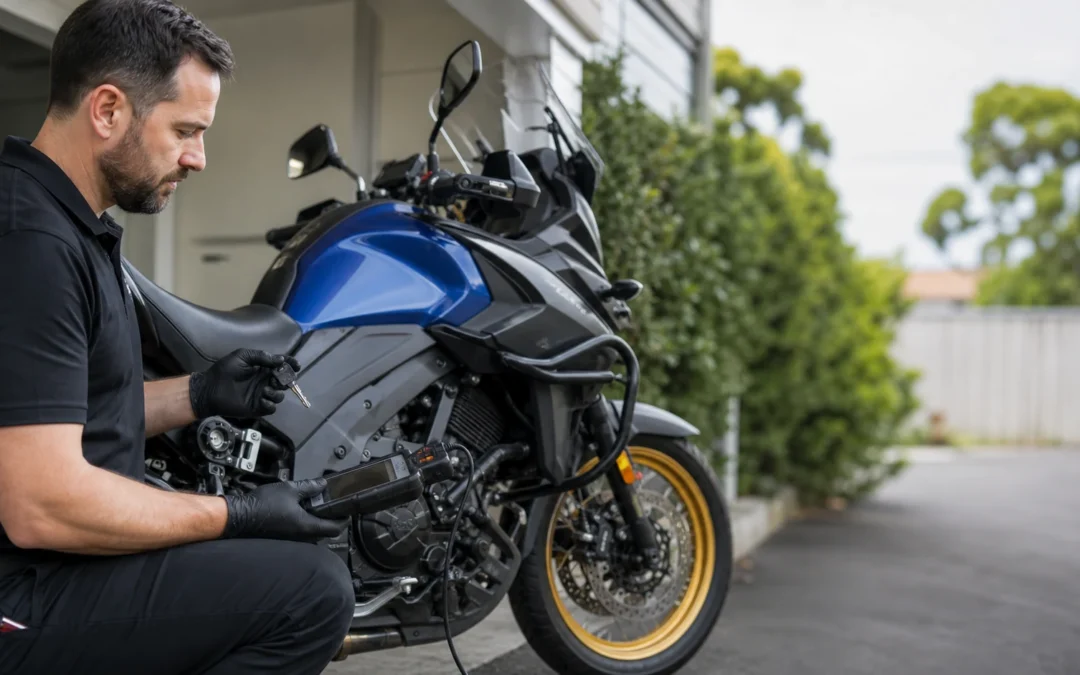
A rider stands beside a Yamaha with a freshly cut key, the ignition barrel turns without resistance, and the engine still refuses to fire. The lock is not the problem.
Somewhere inside that key head sits a small transponder chip, and until it talks to the bike’s ECU in the right language, the immobiliser keeps the fuel and ignition systems locked down regardless of how well the blade was cut.
What a Transponder Chip Actually Does
A transponder is a tiny chip embedded in the plastic head of the key, powered briefly by a magnetic field from a coil around the ignition barrel when the key is inserted or brought close. It has no battery of its own.
The chip sends back a unique identifying code, and the bike’s system checks that code against the ones it has been told to accept.
This is separate from the mechanical cut entirely. A key can be cut with perfect precision to match the lock cylinder and still carry a chip the ECU has never seen before, in which case the barrel turns freely but the engine management system refuses to let fuel and spark systems activate.
Newer systems generally use rolling or encrypted codes that change with each use rather than a single fixed code repeated every time, which makes the chip harder to clone but also means programming equipment needs to stay current with each manufacturer’s encryption method.
Older bikes from the early days of transponder security often used simpler fixed codes, which is one reason a locksmith working across a wide range of bike ages needs several generations of coding software on hand, not just the newest version.
How the Immobiliser Talks to the Bike’s ECU
Once the transponder sends its code, the ECU compares it against a stored list of authorised keys. On most modern motorcycles that list lives in the ECU itself or in a small immobiliser control unit wired between the ignition and the engine management system.
If the code matches, the immobiliser releases its hold and the starter circuit, fuel pump, and ignition coils are allowed to operate normally.
If the code does not match, or no code is received at all, the ECU can cut fuel delivery, block the starter relay, or both, depending on how the manufacturer designed the system.
The bike may crank over on the starter motor without ever actually running, which confuses many riders who assume a cranking engine means the electrical side is fine.
Some manufacturers build in a limp mode rather than a hard cutout, allowing the engine to run briefly at reduced power before shutting down again, as a way of signalling a key fault without leaving the rider completely stranded mid-ride.
This behaviour differs enough between brands that a rider describing the exact symptom to a locksmith, whether the bike refuses to crank at all or starts then dies, helps narrow down whether the fault is the key, the immobiliser wiring, or something else entirely.
Why a Perfectly Cut Key Still Won’t Start the Bike
This is the point where motorcycle key programming becomes a separate job from key cutting rather than an extra step tacked onto the end of it. Programming means writing the new key’s transponder code into the ECU’s accepted list, using dedicated coding tools connected through the bike’s diagnostic port.
Riders who have only ever dealt with older bikes sometimes assume any cut key will work, since that was true before immobilisers became standard equipment on mid-range and larger models.
A new key that has been cut but never programmed will look and feel correct right up until the moment it fails to start the engine.
Brand Differences in Coding Complexity
Most mainstream manufacturers, including Honda, Yamaha, Kawasaki, and Suzuki, use transponder and immobiliser systems that a properly equipped mobile locksmith can read and program using standard dealer-level coding tools connected through the OBD port. Harley-Davidson and BMW models generally follow a similar pattern, though the specific software and key types vary by model year.
Ducati sits at the more involved end of the scale.
Many Ducati models use a master-key and ECU-linked coding system where programming a replacement key can require working directly with the ECU’s stored key data rather than a simpler add-a-key process, a known distinction in the trade between straightforward transponder coding and the more layered systems on some Italian and premium marques.
Triumph models fall somewhere between the two, depending on the platform and year.
Some newer BMW motorcycles add another layer again with keyless ride systems, where the rider carries a fob rather than inserting a physical key at all, and the bike detects its presence electronically to allow the ignition to activate.
Programming a replacement fob for these systems is a different process from cutting and coding a traditional transponder key, closer in complexity to the Ducati end of the scale than to a standard Honda or Suzuki.
On-Site Programming vs a Dealership Booking
Dealerships have the manufacturer’s own diagnostic software and are the default option for some of the more complex Ducati and premium coding jobs. The trade-off is booking lead time, since the bike is typically scheduled in rather than seen the same day, and the rider is without the bike until the appointment happens.
A mobile locksmith carrying dealer-level key coding tools and OBD diagnostics can handle programming for most mainstream brands on site, at the bike’s actual location rather than a workshop. For the more involved Ducati-style systems, confirming in advance whether on-site programming is possible for that specific model saves a wasted callout.
Both routes generally ask for the same proof before programming a key, since adding a new transponder to a bike’s accepted list effectively grants that key full access to start the engine.
A rider should expect to show registration or ownership documents whether the job is booked through a dealership service desk or a mobile locksmith attending the address on file.
Signs Your Bike Actually Has an Immobiliser
Most bikes built in the last fifteen to twenty years carry some form of transponder security, but the visible clues are subtle. A small black plastic collar around the key blade, distinct from the metal cutting profile, usually houses the chip.
Dashboard warning lights that flash briefly on startup, sometimes labelled with a key or lock icon, also point to an active immobiliser system.
Owners who are unsure can check the key itself against the original one, if a second key still exists, or describe the dash behaviour to a locksmith over the phone before booking. This heads off a callout where the wrong equipment was brought for the job.
Older commuter bikes and many smaller-capacity scooters registered before immobiliser systems became standard often run on nothing more than a mechanical lock, in which case a cut key really is the whole solution and no programming step exists.
A locksmith who asks about the bike’s approximate age and model before attending is trying to work out which of these two categories applies, not being unnecessarily thorough.
What Happens During a Programming Visit
The locksmith connects diagnostic equipment to the bike’s data port to confirm the ECU type and read its current programming state, then either adds the new key to the existing accepted list or, where all keys have been lost, resets the system and programs a fresh set.
Testing follows immediately, with the engine started and stopped a few times to confirm the immobiliser consistently recognises the new key.
Programming a transponder key generally involves more time and specialised equipment than cutting a basic mechanical key, since it requires coding a chip to communicate correctly with the bike’s ECU rather than just shaping metal to fit a lock.
For that reason it typically sits at a different point on the price scale than a simple cut key, and getting an exact figure means calling with the bike’s make, model, and year on hand.
When Programming Alone Is Not Enough
Some lockouts involve more than a missing code.
A corroded immobiliser ring around the barrel, damaged wiring between the ignition and the ECU, or water ingress after the bike has been left out in Melbourne’s weather can all interfere with the chip reading correctly even once a key is programmed.
In these cases the electrical fault needs addressing before programming will hold.
Riders who have lost every key to the bike, rather than just needing a spare added, face a slightly different process again, since the ECU’s key list may need a full reset rather than a simple addition.
This distinction is covered from the cost side in this guide to motorcycle key replacement cost in Doncaster, which breaks down what typically pushes a job toward the higher end of the range.
Riders weighing up whether to book a locksmith or a dealership for a VIN-based replacement can also read this comparison of motorcycle key replacement by VIN, locksmith versus dealership, in Doncaster, which sets out where each option makes more sense.
For a diagnosis of whether your bike needs cutting, coding, or both, call Ostan Locksmiths on 0410 380 354 or request a free quote from Ostan Locksmiths and describe the bike’s behaviour when you turn the key.