
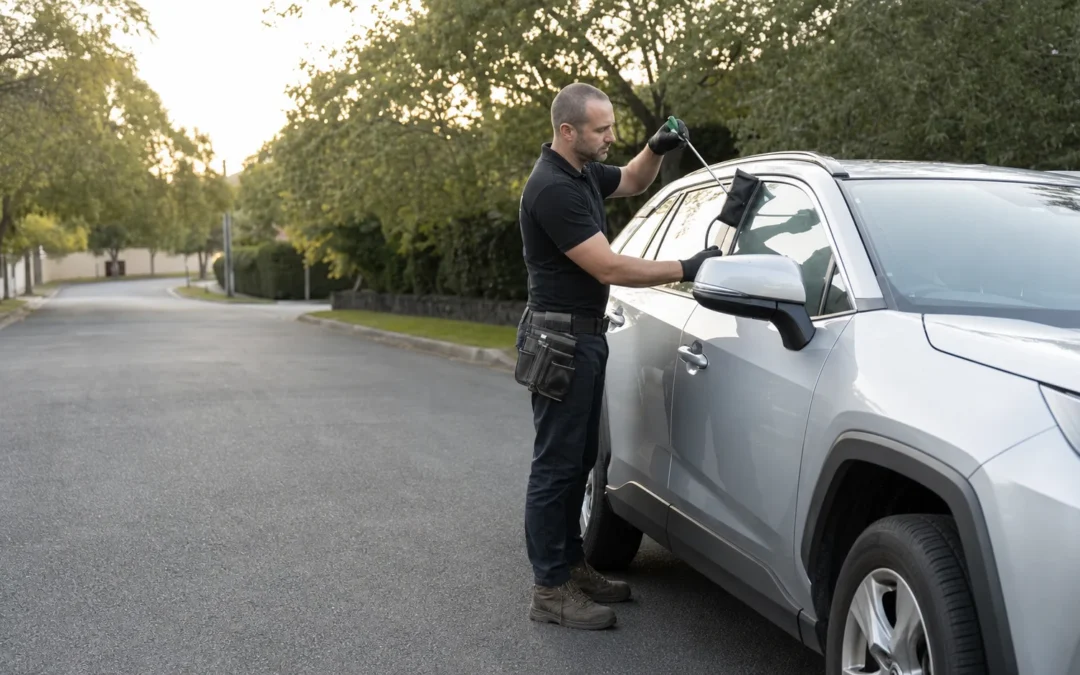
The car door clicks locked with the keys sitting on the driver’s seat and a toddler due for pickup from childcare in twenty minutes.
That moment of realisation feels the same whether it happens outside Westfield Doncaster or on a quiet street in Donvale, and what you do in the next five minutes matters more than most drivers think.
A quick checklist before you call anyone
Before panic sets in, run through a short list of checks. Most of these take less than a minute each and can rule out a problem that has nothing to do with needing a locksmith at all.
- Check every door and the boot, not just the driver’s door, since many vehicles unlock the boot separately from the cabin
- Look for a window left slightly open, which changes the entry options available
- Confirm the keys are actually inside the car and not lost elsewhere, such as a pocket, bag, or the last place you used them
- Ask whether a family member, workplace, or neighbour holds a spare key nearby
- Move to a safe, visible spot if you are on a road shoulder rather than standing in traffic
- Make sure your phone has enough charge, or note the nearest shop or business where you could wait and charge it
Why coat hangers and DIY tools cause more damage than they fix
The wire coat hanger trick worked on some older vehicles with simple mechanical locks, but most cars built in the last fifteen years use central locking, alarm sensors, or keyless systems that a coat hanger cannot engage at all.
Forcing one into the door seal usually just damages the weatherstripping or scratches the paint without opening anything.
Wedging a tool into the door frame to create a gap risks bending the frame itself, which can cause wind noise, water leaks, or a door that never seals properly again afterwards.
The repair cost for a bent frame is often higher than a locksmith call-out would have been in the first place, and it turns a five-minute inconvenience into a panel repair.
Online videos showing quick lockout hacks rarely mention that they were filmed on one specific make and model, often an older one, under ideal conditions.
Applying the same method to a different vehicle with a different lock mechanism is as likely to cause damage as it is to succeed, and there is no way to know which outcome you will get until you have already tried and possibly broken something.
Modern cars make DIY entry harder, not easier
Vehicles with keyless entry, proximity sensors, and alarm systems complicate manual entry attempts even further than older cars did.
Triggering the alarm partway through a DIY attempt can lock the immobiliser into a fault state, meaning even the correct key will not start the car until the system is reset by someone with the right diagnostic tools.
Late-model Mazda, Hyundai, and Ford vehicles in particular use sensors around the door handles and window seals that a fumbled DIY attempt can damage, turning a simple lockout into an electrical fault that costs far more to fix.
A locksmith with the right training reads the specific system on your vehicle before touching it, which avoids triggering these sensors in the first place.
Locksmith or tow truck: which one actually solves it
A tow truck moves the car but does not open it, which means you still need a locksmith or a dealer at the other end, plus you have paid for the tow on top of whatever the locksmith or dealer then charges.
A mobile locksmith comes to wherever the car is, at home, at work, or on the roadside, and opens it on the spot without moving it anywhere at all.
The only situation where towing genuinely makes more sense is when the vehicle has a separate mechanical fault unrelated to the lock, such as not starting even once it has been opened. For a straightforward lockout, calling a locksmith directly is faster and avoids the extra step of arranging and paying for a tow truck.
Roadside assistance membership versus calling a locksmith directly
Plenty of drivers already pay for a roadside assistance membership and assume it is the fastest option for a lockout.
In practice, a membership call-out often gets queued alongside breakdowns, flat batteries, and accident recoveries across a huge coverage area, which can mean a longer wait than calling a locksmith who specialises in lockouts and works a smaller, local patch.
A direct call to a mobile locksmith based in Doncaster skips that queue entirely, since the job goes straight to someone who is already local and equipped for exactly this situation.
If you do have a membership, it is worth checking what it actually covers for lockouts specifically, since some plans limit the number of call-outs per year or charge extra once you exceed it.
Some memberships also send a general breakdown technician rather than a specialist, who may not carry non-destructive entry tools for every lock type and could end up calling a locksmith anyway. Knowing this in advance saves a second wait on top of the first one.
What actually happens once the locksmith arrives
The locksmith checks ownership first, your driver’s licence and the vehicle’s registration are usually enough, then assesses the lock type before selecting a non-destructive entry tool suited to that specific make and model. Most standard lockouts are resolved within a matter of minutes once the right tool is in hand and matched to the vehicle.
If the keys are visible inside and the issue is purely mechanical, no drilling, cutting, or damage to the vehicle is involved at any point.
If it turns out the key itself is faulty rather than simply out of reach, a mobile locksmith carrying key cutting and programming equipment can often sort that on the same visit instead of requiring a second call-out days later.
A standard lockout on an older vehicle with simple central locking is often resolved in five to fifteen minutes.
Higher-security systems on European makes such as BMW or Mercedes-Benz can take longer, since these locks are deliberately designed to resist manipulation, which is exactly why experience across a wide range of brands matters more than owning a single generic tool.
Cutting down the odds of it happening again
A spare key kept with a trusted family member, or a hidden magnetic key box used sparingly, removes the single point of failure that causes most lockouts.
For vehicles with proximity key fobs, keeping a spare fob’s battery fresh matters too, since a flat fob battery can behave like a lockout even when the key is technically in your pocket the whole time.
Getting a spare cut before you need one is far less stressful than doing it after a lockout has already happened. It also means arranging the job during business hours on your own schedule, rather than paying for an urgent call-out to fix something that could have been sorted in advance.
Households with more than one driver benefit from a simple rule: the spare key stays in a fixed, agreed location and never travels with either driver. This sounds obvious, but most repeat lockouts happen because a spare that was meant to stay put ended up in someone’s other bag or a different car entirely.
What if the lockout happens somewhere unusual
A lockout in a multi-level car park, such as those at Doncaster Shoppingtown, adds a layer most people do not think about: giving the locksmith a precise level and bay number saves real time compared to a vague “somewhere in the car park.”
Underground car parks can also weaken mobile phone reception, so texting your exact location as a backup to a phone call is worth doing if the call keeps dropping out.
A lockout on a busier road, such as Doncaster Road or Williamsons Road during peak traffic, is a safety issue as much as an inconvenience. Standing well clear of moving traffic while you wait, rather than staying right beside the car, is worth the short walk to a safer spot.
Rural and semi-rural stretches around Warrandyte, Wonga Park, and Park Orchards bring a different problem: patchy mobile reception and few nearby landmarks to describe your location.
Sharing GPS coordinates through your phone’s map app, rather than trying to describe a bend in the road, gives a locksmith an exact pin to navigate to instead of an approximate area to search.
Getting moving again
If you are locked out right now, call Ostan Locksmiths on 0410 380 354 for non-destructive entry that gets you back in your car without damage.
For a deeper look at how emergency call-outs work more broadly, including night and weekend response, read what to expect from a 24/7 emergency car locksmith in Doncaster, and if a key has actually snapped rather than being locked inside, see what to do about a broken key stuck in the ignition.
The emergency car locksmith team covers Doncaster and the surrounding Manningham suburbs, and you can also request a callback if you would rather arrange a time than call directly.