
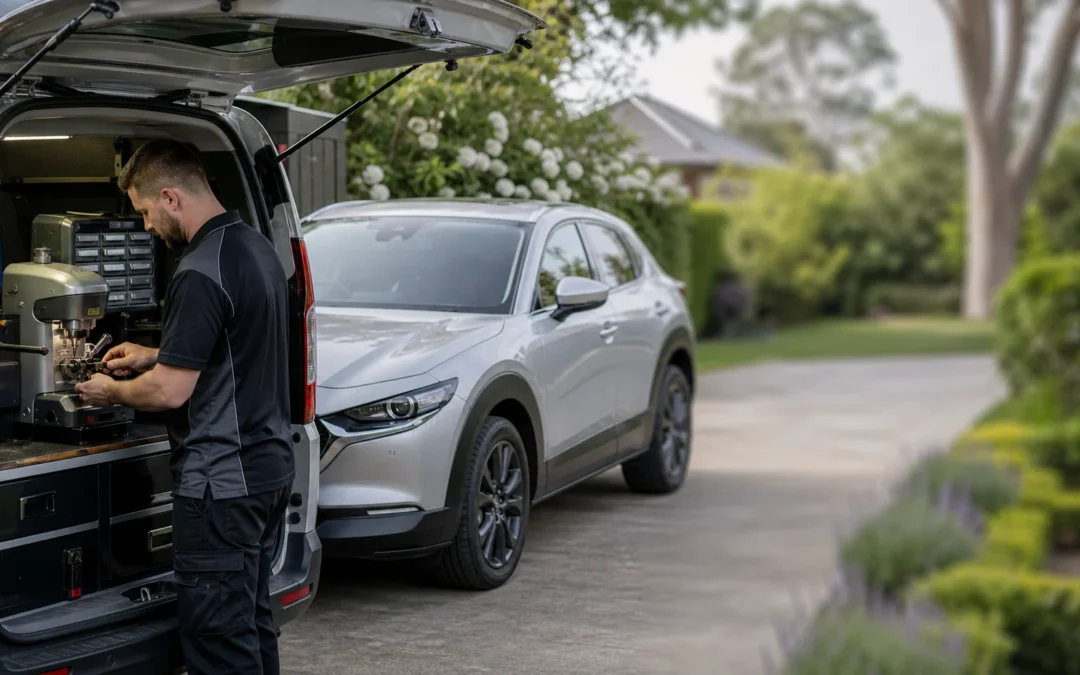
A tenant moves into a rental in Doncaster East and the previous occupant handed back zero keys for the car left in the garage. A tradesperson drops his only set down a stormwater drain on a job in Templestowe Lower.
Both need a working car key made from scratch, with no original blade, no spare, and no chip to copy from. That is exactly what cutting to code solves.
What Cutting to Code Actually Means
Most key cutting people picture involves tracing an existing key on a machine that copies its shape onto a blank.
Cutting to code is different: instead of copying a physical key, the locksmith pulls the exact cut depths and spacings for that vehicle’s lock from a manufacturer code, then cuts a blank to match those numbers directly.
No original key ever needs to be present. The code itself, tied to that specific vehicle, contains everything a cutting machine needs to reproduce a key that fits the ignition barrel and door locks precisely, which is why this method works even when every key the owner ever had is gone for good.
Where the Key Code Comes From
The most reliable source is the vehicle identification number, or VIN, stamped on the vehicle and printed on the registration papers. Manufacturers tie each VIN to a specific lock code at the factory, and that code can be looked up through dealer-level software once ownership is confirmed.
On some older vehicles the code is stamped on the lock cylinder itself or listed on a code card issued at the time of sale, though most owners have long since lost that card.
Where no code is on record, a trained locksmith can decode the lock mechanism directly, reading the depths of the pins or wafers inside the barrel and working out the correct cut from there.
Vehicles imported privately rather than through the official Australian distributor sometimes fall outside the standard code database entirely, since the VIN was never registered with the local manufacturer arm.
In those cases decoding the lock cylinder by hand becomes the only route to a correct cut, which takes longer but still avoids replacing the entire lock assembly.
Laser-Cut and High-Security Keys Need Different Code Tables
Older vehicles mostly used simple edge-cut keys, where the cuts run along one side of a flat blade and a basic code table tells the locksmith the depth at each position.
Many vehicles built from the mid-2000s onward, including several Toyota, Volkswagen, and Subaru models, moved to laser-cut or “sidewinder” keys instead, where the cuts track down the centre of the blade in a wavy groove rather than notches on the edge.
Laser-cut keys demand a different cutting machine altogether, one that can trace a continuous groove rather than punch discrete notches, along with a code table specific to that groove pattern.
A locksmith who only carries edge-cutting equipment simply cannot produce these keys, which is why some general locksmiths turn this work away and refer it to a specialist instead.
Dimple keys, identified by round or oval indentations punched into the flat faces of the blade rather than along its edge, add a third geometry again and appear on some Asian and European models.
Ostan Locksmiths’s mobile setup covers edge-cut, laser-cut, and dimple key formats, so the vehicle’s key style rarely limits what can be produced on site.
Precision Machines Instead of Guesswork
Cutting to code only works if the cutting machine is accurate to a fraction of a millimetre, since car locks tolerate far less error than a household deadbolt. Ostan Locksmiths uses dealer-level key cutting machines calibrated against the manufacturer’s own cut specifications, not a generic hardware-store duplicator built for house keys.
A key cut even slightly off these tolerances can jam the ignition barrel, wear the lock prematurely, or simply refuse to turn. Manual filing or “cut and try” methods, sometimes used by less-equipped operators, risk exactly that kind of damage to a lock that would otherwise last the life of the car.
A slightly undersized cut lets the key turn but wears the internal pins unevenly, so the lock gets looser and less reliable every time it is used, sometimes failing within months rather than years.
A correctly coded cut, by contrast, matches factory tolerances exactly, so the ignition barrel and door locks wear at the same gradual rate the manufacturer designed for.
A Cut Key Starts the Locks, Not Always the Engine
On vehicles with a transponder immobiliser, a code-cut key will turn the ignition barrel and unlock the doors, but the engine will not start until that key’s chip is separately programmed into the car’s immobiliser memory.
The cutting and the programming are two distinct jobs, even though Ostan Locksmiths typically completes both in the same mobile visit.
Our companion article on transponder key programming explains exactly what that chip does and why a mechanically correct key still leaves the engine dead without it. Older vehicles without an immobiliser, including many pre-2000 Holden and Ford models, only need the mechanical cut to be fully functional.
Why This Beats Waiting on a Dealership Blank
A dealership faced with no working key usually orders a blank from the manufacturer, a process that can take anywhere from several days to a few weeks depending on stock and the model’s popularity, and almost always requires the car to be towed to the dealership first since dealers rarely offer mobile service.
Cutting to code on site removes both delays. Ostan Locksmiths carries key blanks for the common makes driven around Doncaster and the eastern suburbs, Toyota, Mazda, Hyundai, Ford, Holden, and a range of European brands, and cuts them to the vehicle’s code in the same visit rather than placing a factory order and waiting.
This matters more in Manningham than in most metro council areas, since it is the only local government area in metropolitan Melbourne without a train line or tram, which means most households depend entirely on their car for work, school, and appointments.
A vehicle sitting immobile for a week or two waiting on a dealership blank is a bigger disruption here than somewhere with regular public transport as a fallback.
All Keys Lost Versus a Single Missing Key
Cutting to code is most valuable in an all-keys-lost situation, where there is nothing left to trace or copy from. Our detailed guide on all keys lost car locksmith solutions covers the diagnostic and immobiliser-access side of that scenario in more depth.
A driver who still has a damaged or worn key but no spare has other options too, including tracing that key on a cutting machine rather than sourcing a fresh code, which is generally faster since no code lookup is needed.
Our article on lost car keys with no spare walks through when each approach makes sense.
Deciding between the two comes down to what is left to work with. A key that still turns the lock but is chipped, bent, or worn smooth on the cuts is usually worth tracing, since the original geometry is still mostly intact.
A key that is snapped in half, buried in a drain, or simply gone for good leaves cutting to code as the only reliable path back to a working set.
What to Have Ready Before the Callout
A locksmith cutting a key to code needs to confirm the request is legitimate before touching a vehicle’s security system, both to protect the owner and to comply with basic trade ethics around vehicle access.
- The vehicle’s registration papers or a copy showing the VIN
- Photo identification matching the name on the registration
- The vehicle itself, parked wherever it currently sits, since the lock cylinder or barrel sometimes needs checking
- Any remaining key fragments, even badly worn or snapped ones, which can speed up the process
Without this information a locksmith cannot responsibly cut and hand over a working key, since doing so without proof of ownership would undermine the exact security the lock and immobiliser are there to provide. Ostan Locksmiths completes this check over the phone or on arrival, so it rarely adds meaningful time to the visit itself.
Getting Back on the Road With a Freshly Cut Key
A car with no working key is not a write-off and does not need a flatbed to a dealership. Ostan Locksmiths brings the code-cutting equipment, transponder tools, and 15 years of automotive locksmith experience directly to the vehicle, whether it is parked in a Warrandyte driveway, a Nunawading car park, or outside a Doncaster shopping strip.
Our car key cutting service covers vehicles with no working key at all, and every job is quoted upfront once the vehicle and situation are confirmed.
Pricing depends on the key type, whether laser cutting or transponder programming is also needed, and the vehicle’s make, so an exact figure comes only after those details are known.
Call 0410 380 354 or request a free quote from Ostan Locksmiths to get a functioning key cut without the wait a dealership order involves.