
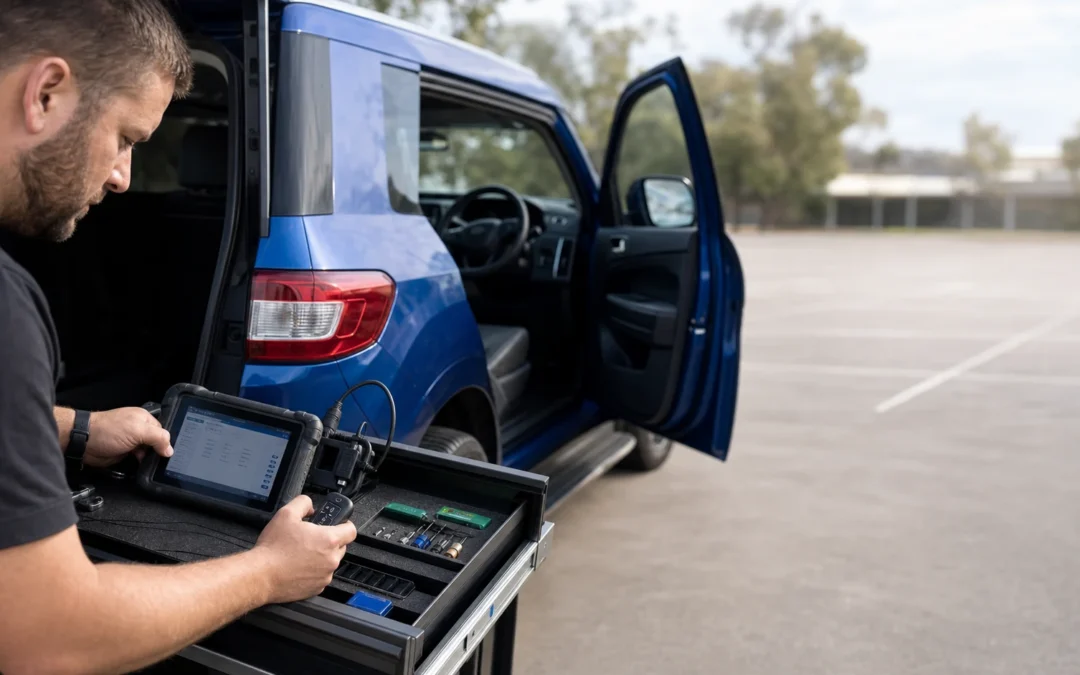
A Hyundai i30 owner in Doncaster East recently searched every coat pocket, the car, and the garden twice before accepting the truth: both sets of keys were gone, one lost weeks earlier and never replaced, the other left somewhere on an interstate trip.
With no key to open the door or start the engine, towing the car anywhere was not even possible without breaking a window first.
This is what locksmiths call an all-keys-lost job, and it is the single most involved scenario in car key work, but not the most complicated to arrange help for.
The steps involved, the reasons it costs more, and how quickly it can realistically be fixed are worth understanding before it happens rather than during the panic of discovering it.
What “All Keys Lost” Actually Means
All keys lost describes a specific technical situation: no working key or fob exists anywhere that the vehicle’s immobiliser system already recognises.
This differs from losing one key out of two, where the surviving key can be read by diagnostic equipment and used as a reference to cut and programme a matching spare.
When every key is gone, there is nothing left to read from, so the entire immobiliser and key system has to be approached from a blank slate.
Why This Is Different From a Simple Lost Key
Replacing one lost key out of a pair is comparatively quick, since the working key already stored in the car’s memory lets a locksmith clone or match a new one to it directly. All keys lost removes that shortcut entirely.
The locksmith cannot copy from an existing key because none exists, so every key that will ever start the car again has to be generated from the vehicle’s own security data rather than from a physical sample.
There is also a second, separate problem to solve first: getting into the locked car at all. With no key and no fob, the doors themselves are locked, so entry has to happen before any immobiliser work can even begin.
How the Re-Key Process Works: VIN, Key Code, and the Immobiliser
The first step on site is non-destructive entry, using pick tools or manipulation techniques suited to that specific door lock design, so the car is opened without drilling, forcing, or damaging the paintwork or window seals. Only once the vehicle is open can the locksmith turn to the ignition and immobiliser side of the job.
Every vehicle has a unique identifier, the VIN, stamped into the chassis and recorded against its factory security profile.
A locksmith uses OBD diagnostics connected to the car’s data port to access this profile, confirm the correct key code, and then cut a blank to match the mechanical lock while also programming a transponder chip, a small embedded chip with its own unique code, to match the electronic side.
The immobiliser then has to be told to forget every key it previously trusted and accept only the new one, a step called erasing and re-registering the key list.
As a general rule across most manufacturers, an immobiliser only holds a small number of registered keys at once, which is part of why the old list has to be cleared before new keys can be added.
On older vehicles with simpler transponder systems, this can sometimes be done through the OBD port alone.
Newer vehicles with smart key or push-button start systems often require the locksmith to also access the vehicle’s onboard computer directly, which takes more time and more specialised equipment than a basic transponder job.
Once the new key is programmed, the technician tests engine start, central locking, and remote functions before packing up, to confirm the immobiliser has fully accepted the change.
What the Locksmith Needs From You Before Starting
Because a stolen vehicle could otherwise be re-keyed by anyone claiming ownership, proof of ownership is required before any all-keys-lost job begins.
This typically means the vehicle’s registration papers matched against photo identification, or in some cases a certificate of roadworthiness paired with proof of purchase for a recently bought car. Having these documents ready before the locksmith arrives shortens the visit considerably.
- Vehicle registration papers or the rego renewal notice
- Photo identification matching the name on the registration
- The car itself, on site, since the VIN and immobiliser have to be accessed directly
For a car bought secondhand where the registration has not yet been transferred, a contract of sale or receipt from the seller alongside personal identification is usually enough to proceed.
This comes up more often than expected, since a new owner sometimes discovers the previous owner only handed over one key, which then goes missing before a spare is ever cut.
Why It Costs More Than a Spare Key
All keys lost is consistently the most expensive category of key job, and the reason is straightforward: it involves full immobiliser reprogramming rather than simple duplication, more time on site, and in some cases specialised access to reach the vehicle’s security module.
A basic spare cut from an existing key takes a fraction of the time and equipment that a full re-key from scratch requires.
Vehicles with push-button start and smart key entry generally cost more to re-key than older transponder-only models, since the fob itself, along with its rolling security code, has to be sourced and paired to the car in addition to the mechanical and immobiliser work.
If the missing keys included a remote for central locking or boot release, that remote and key fob replacement is bundled into the same visit rather than treated as a separate job.
The exact figure depends heavily on the make and model, since some manufacturers use security systems that take longer to access and reprogramme than others, and European makes in particular often carry more layered encryption than mainstream Japanese or Korean models. Car key replacement pricing for an all-keys-lost job is quoted upfront once the vehicle details are known, so call 0410 380 354 or get a free quote from Ostan Locksmiths before assuming the worst about cost.
Mobile Locksmith vs Dealership for This Specific Scenario
A dealership can technically handle an all-keys-lost job, but the car has to reach the workshop first, which usually means arranging and paying for a tow truck since there is no key to drive it there.
A mobile locksmith brings the same VIN-based key coding capability directly to wherever the car is sitting, whether that is a driveway in Bulleen or a shopping centre car park in Doncaster, removing that cost from the job entirely.
For a full breakdown of how mobile and dealership routes compare on cost and turnaround more broadly, see mobile car locksmith versus dealership in Doncaster.
An all-keys-lost situation also tends to happen at inconvenient times, such as after a night out or at the end of a long shift, when a dealership is closed but a mobile locksmith is still reachable.
How Long It Actually Takes
Most all-keys-lost jobs on mainstream makes like Toyota, Mazda, and Ford are completed in a single mobile visit lasting somewhere between one and two hours, depending on how the vehicle’s security system is structured.
Vehicles with more layered smart key systems can take longer, since more steps are involved in erasing the old key data and confirming the new key is fully trusted by the immobiliser before the job is finished.
Booking a dealership for the same job typically means a multi-day wait once towing, workshop scheduling, and parts availability are factored in, particularly if the correct key blank is not already in stock at that branch.
Preventing the Next All-Keys-Lost Situation
Once the car is moving again, cutting a second spare key immediately is the single most effective way to avoid repeating this exact situation.
A spare stored at home, with a trusted family member, or in a separate bag from the primary key set means a future lost key becomes a simple duplication job rather than a full re-key from scratch.
Households that rely on one vehicle, common across Templestowe, Warrandyte, and Park Orchards where public transport options are limited, benefit most from having that second key sorted early rather than after the first key goes missing.
It is also worth asking the locksmith to note the vehicle’s key code on the invoice and filing it somewhere safe at home, separate from the car, since that record speeds up any future job even if a spare is not cut straight away.
Getting Back on the Road
If only one key has gone missing and a working spare still exists, the situation is far less involved than the all-keys-lost scenario covered here.
Read lost car keys with no spare in Doncaster for that middle-ground case, or car key cutting to code in Doncaster for more detail on how a key gets cut from code data alone.
Ostan Locksmiths handles all-keys-lost jobs across Doncaster, Doncaster East, Donvale, Bulleen, Templestowe, Templestowe Lower, Warrandyte, Warrandyte South, Park Orchards, Wonga Park, Nunawading, and Ringwood North, with dealer-level coding equipment carried on every mobile visit. Call 0410 380 354, any hour, to get a car moving again the same day.