
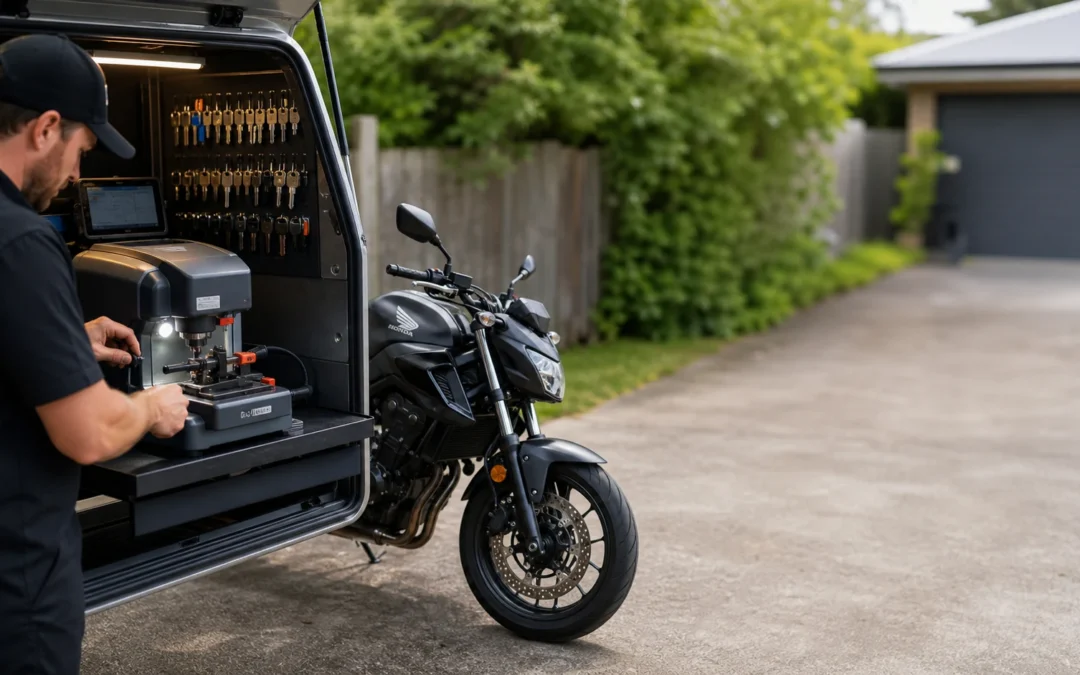
A rider who loses the only key to a Kawasaki or a Vespa scooter does not need someone to copy a key that no longer exists.
They need a locksmith who can cut a new blade from scratch using the lock cylinder’s stamped code or the bike’s VIN, then check it turns the ignition cleanly on the first try.
That process, cutting to code, is a different skill set from copying a key that is sitting on the counter.
What “Cutting to Code” Actually Means
Every ignition and steering lock is cut to a specific internal pattern when it leaves the factory, and that pattern is recorded as a code, either stamped somewhere on the lock itself or logged against the bike’s VIN in manufacturer records.
Cutting to code means producing a blank key that matches that pattern precisely, without ever needing the original key as a template.
This differs from duplicating, where an existing key is measured and copied. When there is no working key left, whether it was lost at a trailhead near Wonga Park or never handed over after a second-hand purchase, cutting to code is the only route to a new key that will actually turn the lock.
Where the Code Comes From: Cylinder Stamps vs VIN Lookup
Some motorcycles have the cut code stamped directly on the ignition barrel or steering lock housing, sometimes hidden behind the barrel face and only visible once the lock is partially removed or accessed with a scope. Reading that stamp gives an exact code without touching the manufacturer’s records at all.
Where no stamp exists or it has worn away, the VIN becomes the reference point instead.
Manufacturers tie a factory key code to the VIN at the point of assembly, so a locksmith with access to the right lookup tools can order or derive the correct cut from the VIN plate alone, usually found on the steering head or frame near the engine.
A factory record shows what the lock was cut to on the day the bike left the assembly line, not necessarily its exact state years later.
Barrels wear unevenly with use, and a lock that has seen a decade of Melbourne weather may have slightly different tolerances than the day it was made.
Cutting the key on site and testing it directly in the actual lock catches that gap immediately, rather than relying on a factory number alone and hoping it still matches.
Why Two-Wheeler Locks Cut Differently Than Car Locks
Car ignition barrels are generally larger, with more room between cuts and a wafer or pin system built for a bigger key blade.
Motorcycle and scooter barrels are smaller and often use tighter cut spacing, which means a cutting machine calibrated for car keys can produce a blade that is close but not accurate enough to turn a bike’s lock smoothly.
A locksmith cutting to code for a two-wheeler needs equipment with finer tolerances and depth settings suited to motorcycle-specific key blanks. Getting even one cut fractionally wrong on a tight motorcycle lock can mean the key binds partway through a turn rather than seizing completely, which is a frustrating fault to diagnose after the fact.
Blank stock is another point of difference. Motorcycle key blanks vary by manufacturer and even by model year within the same brand, so a van stocked only with common car blanks cannot produce a correct cut regardless of how accurate the code is.
Carrying a broad range of motorcycle-specific blanks, from older Honda and Yamaha profiles through to newer Suzuki and Kawasaki shapes, is what makes same-visit cutting possible instead of a special order.
When Cutting to Code Is the Only Option
A key lost somewhere along the Yarra trails or dropped down a drain leaves nothing to copy from, which makes cutting to code the default path. Second-hand bikes bought without a spare key fall into the same category, since the seller’s key may never turn up.
Keys that have snapped off inside the ignition barrel present a related problem. Even if a fragment remains, it usually is not enough to measure a full blade from, so the locksmith works from the code instead.
Riders dealing with a snapped key rather than a fully lost one may want to read this guide on broken motorcycle key extraction in Doncaster before deciding whether extraction or a full recut is the faster fix.
A Cut Key Is Only Half the Job on Modern Bikes
Cutting to code produces a key that fits the mechanical lock and will turn the ignition barrel. On any bike fitted with a transponder chip or an electronic immobiliser, that mechanical fit alone will not start the engine, since the ECU also needs to recognise the chip embedded in the key head.
For older bikes without electronic security, a precisely cut key is the entire solution and the bike starts as soon as the barrel turns. Riders are often surprised to learn which category their bike falls into, since immobiliser systems became common on many mid-range and larger bikes well before most owners think to check.
What a Locksmith Needs From You Before the Callout
The VIN, usually stamped on the steering head or engine casing, is the single most useful piece of information a rider can have ready. A photo of the ignition barrel, even from a phone camera, helps confirm the lock type before the locksmith arrives with the right blank.
Proof of ownership such as registration papers matters too, since a locksmith cutting a new key to code for a motorcycle needs some assurance the person requesting it actually owns the bike. This is standard practice across the trade and protects owners from anyone else obtaining a working key to their bike.
Knowing whether the bike has ever had aftermarket security fitted, such as a disc lock alarm or an aftermarket immobiliser bypass, also helps.
These additions sometimes interact with the factory lock system in ways that are not obvious until the new key is tested, so mentioning any modifications when booking avoids surprises during the callout itself.
Cutting to Code for Scooters vs Full-Size Motorcycles
Commuter scooters, the kind ridden daily between Doncaster East and Nunawading, often use a combined ignition and steering lock in a single compact housing, which changes how the code is accessed compared with a full-size motorcycle where the ignition and steering lock may be separate units.
Larger touring and sports bikes sometimes add a second lock for a fuel cap or a seat latch keyed to the same code, so cutting to code on these models may mean producing one key that operates several locks rather than just the ignition.
Confirming which locks the new key needs to open avoids a second visit later.
On-Site Cutting Saves a Trip to a Dealership
Dealerships can order a key cut to VIN, but the process usually involves the bike being dropped off or booked in weeks ahead, and the rider is without transport in the meantime.
A mobile locksmith who cuts to code on site removes that wait entirely, since the cutting machine, code lookup tools, and blanks travel in the van.
This matters most for riders with no second vehicle, a common situation across the City of Manningham given the lack of any train or tram service in the area.
Getting the bike moving again the same day, rather than the same fortnight, is the practical difference between a mobile motorcycle key cutting visit and a dealership booking.
Dealership parts departments also tend to order blanks from a central warehouse rather than holding broad stock locally, which adds courier time on top of the booking delay.
A mobile locksmith carrying blanks and cutting equipment in the van removes that supply chain step entirely, cutting the key at the first visit rather than a follow-up appointment once parts arrive.
What Happens After the Key Is Cut
Once the blade is cut, the locksmith tests it in the ignition barrel and, on any lock with a steering component, in the steering lock too, checking for smooth engagement rather than a rough or partial turn.
If the bike has a transponder or immobiliser, programming the chip follows immediately after the mechanical fit is confirmed, and a final start-up test on the engine itself confirms the whole system is working together rather than just the lock.
Riders who have already lost their only key and are deciding between a full replacement and other short-term options can compare approaches in this overview of lost motorcycle key options in Doncaster, which covers what happens before a new key is even cut.
If your bike’s key is lost, snapped, or simply never existed as a spare, call Ostan Locksmiths on 0410 380 354 or request a free quote from Ostan Locksmiths for a mobile cutting and coding visit anywhere across Doncaster and the surrounding suburbs. Have the VIN ready and the callout moves faster from the moment the locksmith arrives.